
These policies are living documents—starting points for ongoing improvement and community collaboration. We welcome your feedback as we shape them together.
We envision a California where financial strength starts from the ground up—strong localities fueling a strong state. We believe in trickle-up prosperity, where fiscal responsibility, public investment, and economic accountability serve the common good. It’s time to move beyond corporatism and build a truly human-centered economy.
The Problem:
(Jump to solutions)California must move beyond corporatism and prioritize capital investments that improve human welfare—not just enrich the wealthiest. Fiscal responsibility starts with minimizing waste, increasing transparency, and enforcing stricter reporting for publicly funded organizations. Our cities must break the cycle of insolvency and mounting liabilities that have led to widespread decline and infrastructure failure. A human-centered capitalist economy is possible—through smarter regulation, curbing special interest influence, and raising the economic floor for workers. Infrastructure investments should focus on revitalizing cities, not fueling endless highway expansions.
Paths Forward:
These policy recommendations are not all-inclusive.
Strengthening Local Economies and Infrastructure 🏘️
Focus on building prosperity in our local communities and reduce the income gap among Californians.
At Forward, we believe lasting change begins from the bottom up. Our communities are the foundation of California’s future — and rebuilding trust in our systems starts by ensuring our cities and neighborhoods are financially strong, flexible, and empowered.
Too many localities across the nation are stuck in slow decline, struggling with mounting debt, deteriorating infrastructure, and outdated zoning laws. Instead of accepting insolvency as inevitable, we must prioritize local solvency through responsible budgeting with low or no public debt, maintenance of city corridors, improved land use, and flexibility in zoning and permitting. Such reforms empower cities to make smart, scaleable, iterative, and practical improvements without risking bankruptcy.
At the same time, California faces a growing crisis of income inequality. While the highest earners continue to thrive, middle- and low-income families are falling behind due to stagnant wages and rising costs. Programs like universal basic income (UBI) and stimulus checks can offer short-term relief, but as one study puts it, “cash alone cannot address [systemic] challenges such as chronic health conditions, lack of childcare, or the high cost of housing.”* Immediate infrastructure updates are critical to limit the impact of income inequality on our communities, particularly within the healthcare and child care sectors.
Examples:
-
✅ Improving our cities' financial standing will allow cities to invest in infrastructure that grows with the city. Better Block Placemaking has transformed undesirable spaces in neighborhoods and increased city revenue, one block at a time. Additionally, it encourages local feedback and allows citizens to fully engage in bettering their communities. Source: Better Block Placemaking
✅ Improved land use will create more opportunities for business, recreation, and socializing. Love Your Block in San Bernardino gives grants to residents to help clean up community spaces. This helps cities engage the community and helps residents invest in their own neighborhoods. Source: San Bernardino Love Your Block
✅ Comingle presents a citizen-led effort to bring guaranteed income to those who opt-in, with no government strings attached. Source: Comingle
Additional Sources:
- "Sam Altman's basic-income study is out. Here's what it found." - Business Insider*
- Open Research’s Unconditional Cash Study
- "California’s Economy—Past, Present, and Future" - Public Policy Institute of California
- "Why The Rich Get Richer And The Poor Get Poorer" - Forbes
Reevaluate How We Measure Success 📊
Adopt metrics that reflect real economic pressure on Californians.
Official reports may show a healthy economy—strong job numbers, rising GDP, and even a multi-billion-dollar state surplus, but many Californians aren’t feeling it. In fact, public confidence in the economy is near historic lows.Why? Because the everyday costs that matter — especially food and housing — remain painfully high, well above pre-pandemic levels and the national average. We need new economic indicators that better reflect what people are actually experiencing, not just what’s on a spreadsheet.
At the same time, California can no longer assume that prosperity will take care of itself. The abundance of resources experienced by California for decades has made our state slow to adapt and solve our own problems.
Our state leaders must begin to acknowledge policy failures and make changes, instead of pouring endless taxpayer dollars toward the same structural problems. We must learn to approach our challenges with humility and innovation, and embrace iteration, flexibility, and feedback as strengths, not weaknesses.
Loosening the grip of special interests on our lawmaking is critical in order to redirect capital investments and budget surpluses from outdated infrastructure money pits like endless highway expansions, toward improving the real drivers of human wellbeing: housing, healthcare, education, and community resilience.
Examples:
-
✅ Adopting updated economic models — such as a “real-feel GDP” — can more accurately reflect the financial stress Californians are experiencing, bridging the gap between traditional economic metrics and real household sentiment. Source: "The paradox between the macroeconomy and household sentiment" - Brookings
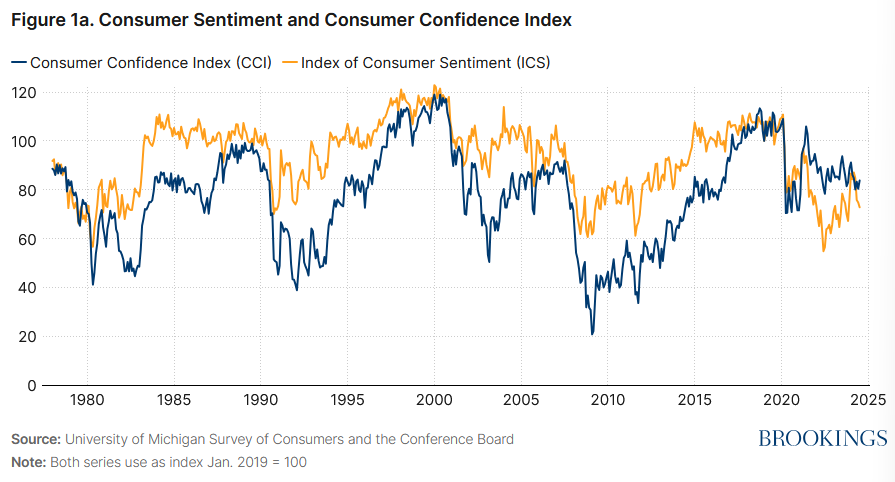
✅ 87% of Forward Party members say the economy isn’t working for them, according to a recent survey. The disconnect between reported economic growth and lived experience is clear—and it’s time to address it directly.
✅ Embedding flexibility and humility into state decision-making is critical to California’s long-term success. That means regularly reevaluating how we define and measure progress—and being willing to acknowledge when policies fall short. California’s high-speed rail project, once a symbol of visionary infrastructure, now highlights the dangers of rigid planning, cost overruns, and an unwillingness to course-correct. We must do better by learning from these failures and adjusting as needed. See: Office of the Inspector General report on high-speed rail.
Sources:
Human-Centered Economy 👨👩👧👦
Build an economy around people—not profit margins.
A truly human-centered economy prioritizes the thriveability of its people, not just productivity or corporate profit. That work begins locally.
Beyond achieving city solvency, we must reduce unnecessary regulations and barriers for small businesses, invest in walkable and safe communities, and expand access to essential services. Zoning and permitting reform is key to supporting homeownership, affordability, and livability in our cities.
We must also prepare both businesses and workers for the accelerating impacts of AI and automation. That means proactive regulation, clear worker protections, and a commitment not to offload these urgent challenges onto future generations.
Our workers are the backbone of both our economy and our communities. Building a future that respects their contributions means rethinking the status quo—from exploring 4-day or 32-hour workweeks to ending tax breaks for companies that fail to provide living wages. No one should be forced to rely on tips to survive while working full-time.
Examples:
-
✅ Shifting priorities from short-term profit to thriveability means centering people — not corporations — in our economic decisions. Strong Towns offers a compelling vision of what a human-centered city can look like. See: Strongest Town Winners.
✅ A human-centered economy reflects the full scope of people’s lived experience, not just the stock market. In a recent Forward National member survey, 44% of respondents named the cost of groceries as the top issue in their daily lives requiring policy solutions.
Our next area of focus will be economic policy, which we'll be covering for a few weeks. What is the most important aspect of your personal finances in need of policy solutions?#ControlWhatYouCan
— Forward Party (@Fwd_Party) April 12, 2025
✅ Reducing overregulation of small businesses and zoning barriers opens up opportunity while still protecting workers. As automation transforms the workforce, California’s overly complex regulatory code — the most extensive in the nation — underscores how urgently we need smarter, streamlined policies. See: "California's Regulatory Landscape".
Additional Sources:
- "Cutting Red Tape To Spur Economic Growth" - Discourse
- "Californians would lose AI protections under bill advancing in Congress" - CalMatters
- "Kosmont-Rose Institute 2024 Cost of Doing Business Survey" - Rose Institute
- "Worker protection laws aren't ready for the automated future of work" - Fast Company
- "Proposition 32 was just rejected. In blue California, why did the minimum-wage boost fail?" - Los Angeles Times